Keep your methodology
Your systems, your risk criteria, your ISO 42001 controls and your own formats. You start with what you already have.
Platform
All-in-one GRC platform
AI built into every module
The common engine behind every module
GRC tailored to your industry
Connect GlobalSuite® to your tools
Standards and frameworks
ISO standards
Regulations
Document once, comply with all.
Resources
 Success storyEMT Madrid centralises its data protection management in GlobalSuite®Read the story

 G2 reviewsWhat the people who use GlobalSuite® every day say about itRead reviewsA customer? Leave a review
Popular searches
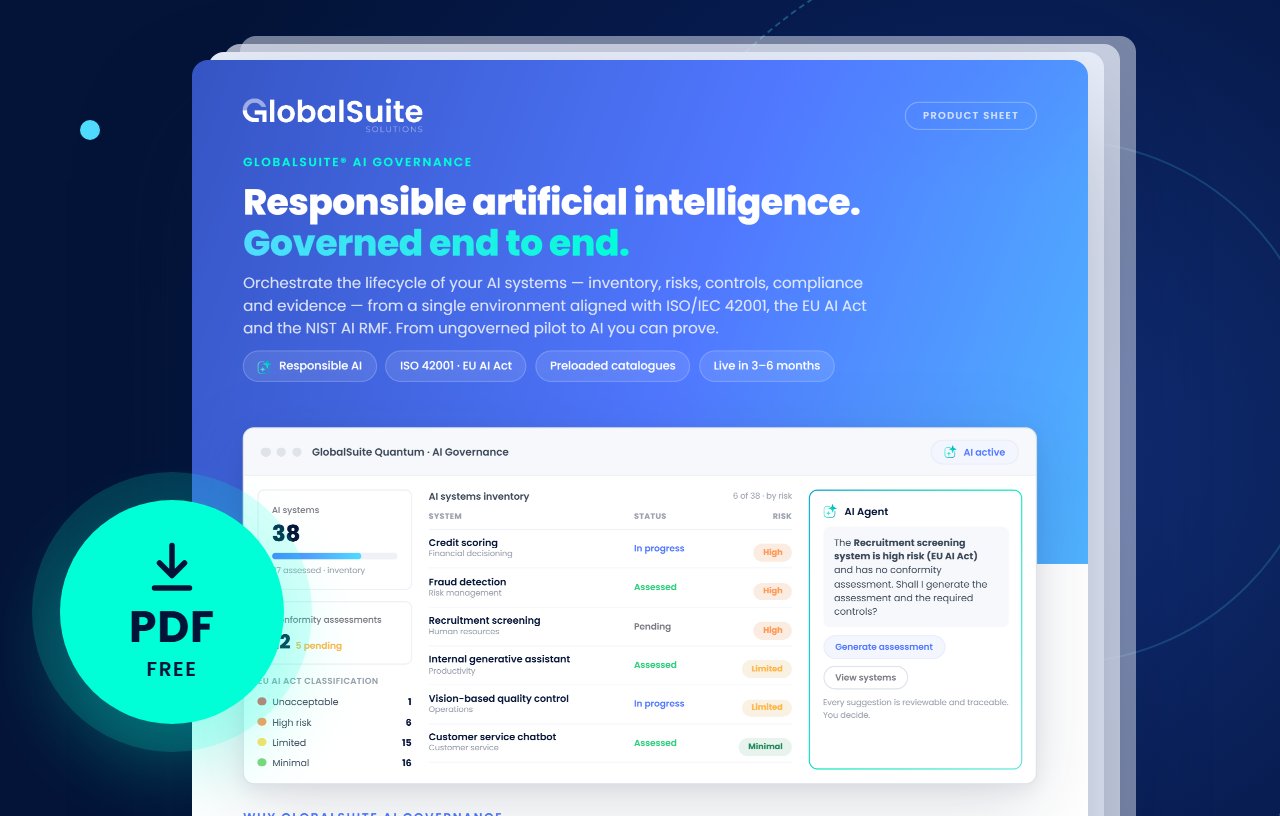
AI system inventory, risk classification, high-risk requirements, monitoring and model providers in one place. From your first inventory to the technical documentation required by Regulation (EU) 2024/1689.
4,4 · 105 reviews on G2
2,000+ companies trust GlobalSuite®













What the Regulation asks for, what you've already done and what's still missing, all on one platform. Screens show sample data.
Every requirement of the Regulation with its applicability, its status and its level of compliance.
Every requirement of the Regulation with its applicability, its status and its level of compliance.
The AI cross-checks your software contracts against the inventory and finds the AI systems nobody had declared. You add them with their risk level, ready to be rated.
AI reads each system record and suggests which articles apply and why. You review it and sign it off.
Every alert from a model in production opens a ticket, with its priority, its status and the system affected.
Every model provider with its rating and the questionnaire on the documentation it has given you.
Word and Excel templates for each report the Regulation asks for, filled in with data from the inventory and each system.
You set up the workflow once and GlobalSuite® repeats it: it requests, reminds, collects and updates. Your team only steps in when there's a decision to make.
Your systems, your risk criteria, your ISO 42001 controls and your own formats. You start with what you already have.
System inventory, technical documentation and impact assessments, up to date and ready to download.
Before each deadline, the agent goes through the inventory, finds systems that are unclassified or lack evidence and prepares the plan. You just approve it.
Inventory, risk management and human oversight are the foundation of ISO 42001 and the NIST AI RMF, and the personal data each model uses is already in your GDPR records. In GlobalSuite® you do it once and it counts for all of them.
Our own estimate of how much of each standard is covered: each requirement counts in full if it is covered the same way and half if only partly. Each standard adds its own requirements.
GlobalSuite® connects to your ecosystem via API. Data comes in on its own and nobody has to copy it by hand.
 Power BI
Monitoring
Vulnerabilities
Data lake
And the module is part of the GRC platform. The systems, data and suppliers you register for the AI Act are the same ones used by ISO 42001, privacy and third-party risk.
If you already work with ISO 42001, the inventory and the assessments are already done.
Your team leads the way. GlobalSuite® automates your management system and, if you need it, our consultants support you at whichever step you choose.

Rail transport · 14,000+ employees
As we rolled out risk management and compliance processes, and given the size of the company and the range of its activities, we needed software that would make risk management more effective and efficient.
Diego Molero AlonsoDirector of Internal Audit, Compliance and Business Risk · Renfe
It reduces tool fragmentation and centralizes all evidence, documentation, controls, and assessments in one place.
Simple and focused on what matters. I implemented it in a large company (more than 30k employees across the world) in 2 months with the support of GlobalSuite consultants.
It is very easy to use, and when we have had a problem, the support people are very helpful. It is easy to implement.
Shall we look at it with your risks and your methodology?
Request a demoCan't find your question? Tell us about your case and we'll answer it with your situation in mind.
Tell us about your caseTell us what you need and we’ll show you how GlobalSuite® solves it.