




An AI system inventory is the list of every artificial intelligence system an organisation uses or develops, with its purpose, its owner, the data it processes, the company's role in each one and its risk level under the AI Act. It is the starting point for any AI Act or ISO/IEC 42001 compliance programme: without it you cannot tell which systems are high-risk or which obligations apply.
The Regulation never uses the word "inventory", yet every one of its obligations assumes you know which systems you have. And the hard part is not filling in the list. It is finding what is missing from it.
What counts as an AI system
Article 3(1) of Regulation (EU) 2024/1689 defines an AI system as a machine-based system that operates with some degree of autonomy and that, from the input it receives, infers how to generate outputs such as predictions, content, recommendations or decisions. The word that separates AI from ordinary software is "infers". A spreadsheet with fixed formulas is not AI; a model that learns from data to score customers is.
In February 2025 the Commission published guidelines on the AI system definition, with examples of what falls inside and outside it. When in doubt, our rule is to put the system in the inventory and record why it was ruled out. A documented exclusion is far easier to defend than a system that simply never appeared.
Where the undeclared AI is
If you only ask each department which AI they use, you will probably hear about in-house projects and the chat assistant the company bought. The rest stays hidden because nobody thinks of it as "an AI system":
To find it, we would combine three sources rather than rely on a questionnaire alone:
- Contracts and purchasing. Go through software contracts and subscription spend looking for AI features. This is the most reliable source, because anything that gets paid for leaves a trail.
- A short questionnaire for each department. Five or six questions about the tools they use to decide, classify or generate content, with concrete examples. Open questions ("do you use AI?") get empty answers.
- Technical logs. The IT team can see in the proxy or the single sign-on which AI services are being used from the company network.
What to record for each system
A useful inventory is more than a list of names. For each system, at a minimum:
| Field | Why it matters |
|---|---|
| Name, purpose and business area | What it does and in which process. The purpose decides whether it is high-risk. |
| Named owner | One accountable person, not a department. |
| Supplier or in-house build | Who to ask for documentation and who answers for what. |
| Company's role | Provider, deployer, importer or distributor. Each role carries different obligations. |
| Data it uses | If it processes personal data, link it to the GDPR record of processing activities. |
| People affected | Customers, employees, job applicants, citizens. This weighs on the risk level and on the FRIA. |
| Risk level and rationale | Prohibited, high, limited or minimal, with the article or Annex III point that justifies it. |
| Status | Pilot, production or retired. A pilot nobody switches off ends up in production. |
The company's role deserves a note. A company that buys a system is usually its deployer, with the obligations in Article 26. But under Article 25, if it puts its own name or trademark on the system, makes a substantial modification or uses it for a high-risk purpose the provider did not intend, it takes on the provider's obligations. This can easily happen without anyone noticing, and the inventory is where it shows up.
How we would keep it up to date
An inventory built once goes stale within months, because new AI features appear every quarter in tools you already use. What we would do:
- Add the question "does it include AI?" to the software purchasing process and to project intake, so new systems come in on their own.
- Review the full inventory at least once a year and whenever a system's purpose changes.
- Ask the provider of each system for the documentation the Regulation requires of it, especially the instructions for use, and file it with the system record.
- Link each system to its risks, its controls and, if it is high-risk, its fundamental rights impact assessment.
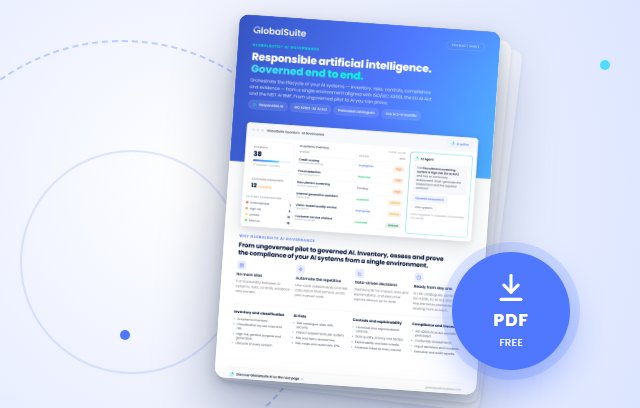
In GlobalSuite® AI Governance the inventory comes with the AI Act risk levels built in, and every system goes through a classification questionnaire. Its risks, requirements and incidents are linked from the system record, so the inventory is the foundation for everything else rather than a separate list.
The deadlines for having all of this in place are in the AI Act timeline after the Digital Omnibus.